
By Patrick Galleher, originally published on Forbes.com
Patrick Galleher is the Managing Partner of Boxwood Partners, an investment bank in Jupiter, Florida, where he leads sell-side transactions.
AI is here. Everyone wants to discuss whether it’s here to stay or whether it’s just a fad that will eventually sputter out.
From the business perspective, certain companies are looking at it as a tool for efficiency, while others might see it as a replacement of labor for cheaper costs. I’ve also seen it used in a much more median way, which I think could be the most cohesive way AI and businesses can coexist in the years ahead.
Overview Of The Home Services Industry
Within the home services industry, business hasn’t stopped booming. Even during the worst year for homeownership and home sales in our country’s history, 2009, 4.6 million homes were still sold and in turn, those homes needed inspections, services and general upkeep.
Even with economic uncertainty looming over U.S. home buyers and sellers now, the home services industry is an industry worth over $500 billion as of this year, with no signs of slowing down. People who aren’t moving are hunkering down and fixing up their homes for the long haul, while those that are moving are ensuring their property passes the inspection to get it sold more efficiently.
With an industry that lucrative, it would make sense that tech would make its way into it.
However, from what I see, these businesses are as human-powered as ever. AI is only coming in to help improve profitability and customer engagement through a host of marketing and customer relationship management techniques.
Overcoming Over-Automation And Consumer Distrust
When we mention AI being implemented into business, I find consumers automatically assume it means things like AI-powered drive-thru ordering, which has led to frustration and is clearly a poor replacement for human interaction.
What businesses get wrong about AI is that it needs to improve the customer experience; customers can tell when technology creates friction.
If a homeowner has a burst pipe, a broken HVAC unit in the middle of July or mold in their attic, they do not want to explain that urgency to a chatbot that cannot understand the context of their issue. They want answers, speed, confidence and above all, a trusted solution.
The question should not be, “How do we replace the person?” Rather, it should be, “How do we improve that person?”
The businesses pursuing the latter are future-proofing themselves.
AI In Home Services
In home services, AI can’t replace technicians, inspectors or crews. A robot can’t (currently!) climb up on a ladder, paint your house or re-do your roof.
But what AI is doing is helping these operators become more efficient. Brands in residential services are using AI to improve the parts of the business that often create friction: lead qualification, scheduling, estimating, routing and customer communication.
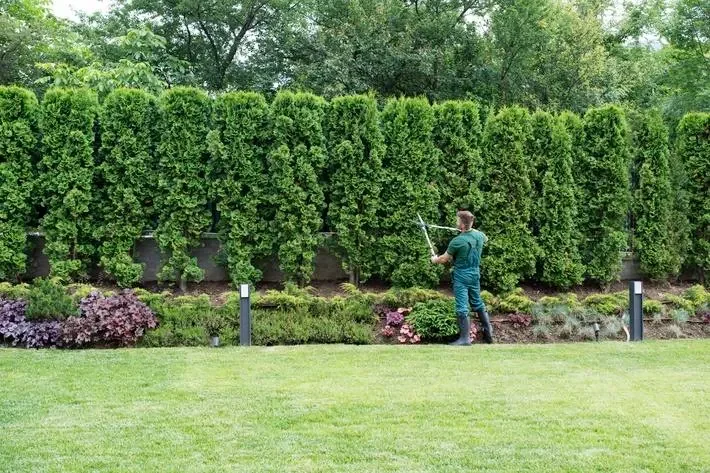
Take lawn and tree maintenance, for instance, one of the most labor-intensive and skill-driven service categories. But technology is helping operators work smarter. Digital estimating tools can help franchisees assess jobs and improve the route and efficiency of the workers. That means faster turnaround and better margins.
The same applies to restoration and remediation brands, which I’ve seen advising franchise owners to prepare for AI-driven insurance claims processing, recognizing that carriers are increasingly using AI to analyze estimates, photos and documentation during the approval process. Restoration businesses now have to think beyond the physical work itself and adapt to how technology is influencing reimbursement and project timelines.
In the background of all of this are AI-driven CRM tools helping these small businesses remain connected within the communities where they work. Not only does this help with lead flow, but once a job is done, they can follow up and reconnect to their customers faster.
This is where AI becomes less about replacing labor and more about improving the systems around it. A homeowner still wants an expert in the living room explaining the issue—a physical person they can trust. But if AI can shorten the claims process, tighten documentation, improve scheduling and reduce wasted time, that creates a better experience for everyone involved.
Future-Proofing Humanity
Residential services may be one of the most AI-resistant industries in America because the work itself still requires skilled labor, trust and execution. And that may be where home services get AI right: not by replacing the worker, but by making the business around their worker faster, smarter and more profitable.
You can never say never. There may one day be a robot that can replace the siding of a home. However, from what I’ve seen, the human connection in small businesses and in communities everywhere is still vital in success.